Auditing Urban Emissions: The Mobile Crusher in Sustainable Construction
Urban development operates under the constant threat of environmental injunctions. During an audit of a massive city-center demolition project in London this April 2026, the principal contractor faced a severe compliance crisis. Local authorities threatened to revoke their operational license due to the relentless diesel exhaust and traffic congestion caused by 50+ dump trucks hauling concrete rubble to a distant landfill. The traditional linear model of “demolish, haul, and dump” is no longer legally or financially viable in modern municipalities. Integrating a Mobile Crusher in Sustainable Construction resolves this environmental friction at the source. By processing Construction and Demolition (C&D) waste directly on-site, contractors neutralize their carbon footprint, secure vital LEED certification credits, and instantly transform a regulatory liability into a steady supply of recycled structural aggregate.
Decarbonizing the Supply Chain: On-Site C&D Recycling
Transporting waste off-site and importing fresh aggregate creates a double-penalty on carbon emissions.
The carbon footprint of a demolition site is heavily dictated by logistics. Every heavy-duty truck leaving the site with rubble and returning with fresh gravel burns massive volumes of diesel, exponentially increasing the project’s overall emissions. The deployment of a crawler-tracked mobile impactor, such as the Vertex VTI1313, eliminates this logistical redundancy. Driven directly into the confined urban footprint, the tracked chassis maneuvers through the debris field to process the waste exactly where it falls.
By fracturing the 800mm concrete slabs down to a usable 0-30mm base layer aggregate, the contractor establishes a closed-loop material economy. The recycled aggregate is immediately repurposed for the new building’s foundation. This elimination of external haulage cuts diesel exhaust emissions by up to 60%, drastically lowering the expenditure per shift while ensuring strict regulatory adherence to municipal carbon quotas.
Acoustic and Particulate Compliance in Urban Zones
Crushing concrete generates intense kinetic energy, which inevitably produces silica dust and mechanical noise. In dense urban zones, exceeding the strict 10mg/m³ particulate limits or breaching community decibel thresholds results in immediate, catastrophic project shutdowns.
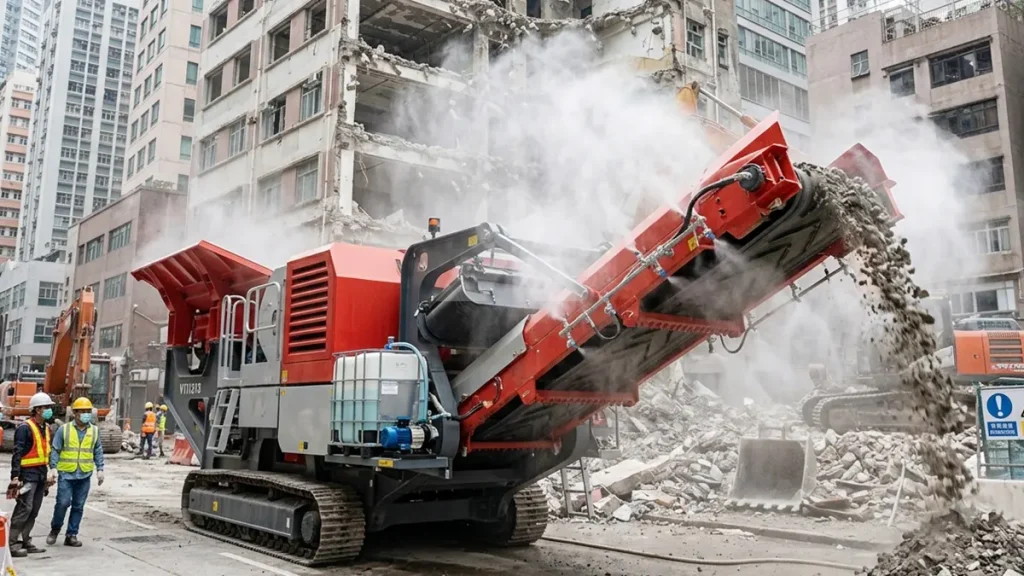
Modern mobile crushers are engineered as self-contained compliance engines. The VTI1313 utilizes localized acoustic enclosures over the 180 kW drive motor and implements rubber-insulated mountings across the vibratory feeder. This acoustic engineering absorbs low-frequency vibrations before they resonate through the chassis. Furthermore, fully enclosed transfer points and integrated atomized misting systems neutralize the dust at the point of fracture, ensuring the site remains invisible to local environmental monitors.
Synchronized Configuration for Urban Demolition
A sustainable site requires equipment scaled to fit within confined physical and regulatory boundaries.
| Compliance Stage | Recommended Equipment | Capacity (tph) | Power (kW) | Environmental Function |
|---|---|---|---|---|
| Confined Space Primary | VTJ9060 Tracked Jaw | 180-240 | 150 | Low-noise concrete slab reduction |
| Rebar & Concrete Recycling | VTI1313 Tracked Impactor | 180-240 | 180 | High-yield recycled aggregate shaping |
| Electric Drive Alternative | VTI1313E (Electric) | 180-240 | 180 | Zero diesel emissions via grid connection |
| Material Classification | VTS-F5015 Tracked Screen | 500-700 | 45 | Dust-enclosed final aggregate grading |
Selecting the electric-drive variant (VTI1313E) elevates the project’s sustainability profile. By plugging directly into the city’s power grid, the contractor eliminates the diesel generator entirely, achieving absolute zero tailpipe emissions on-site while matching the kinetic performance of traditional hydraulic models.
Urban C&D Recycling: Emission & Yield Thresholds
- Carbon Offset: 60% reduction via elimination of external dump truck haulage
- Particulate Control: Sustained < 10mg/m³ via high-pressure misting logic
- Acoustic Limit: Maintained under municipal dB codes via motor enclosures
- Rebar Recovery Rate: >98% extraction via over-band magnetic separation
- Recycled Aggregate Yield: 180-240 tph continuous baseline
Magnetic Separation and Aggregate Purity
Recycled concrete is useless if it is contaminated with structural steel. Utilizing contaminated aggregate in new foundations violates engineering codes and compromises structural integrity. The mobile impact crusher resolves this metallurgical conflict internally during the fracture phase.
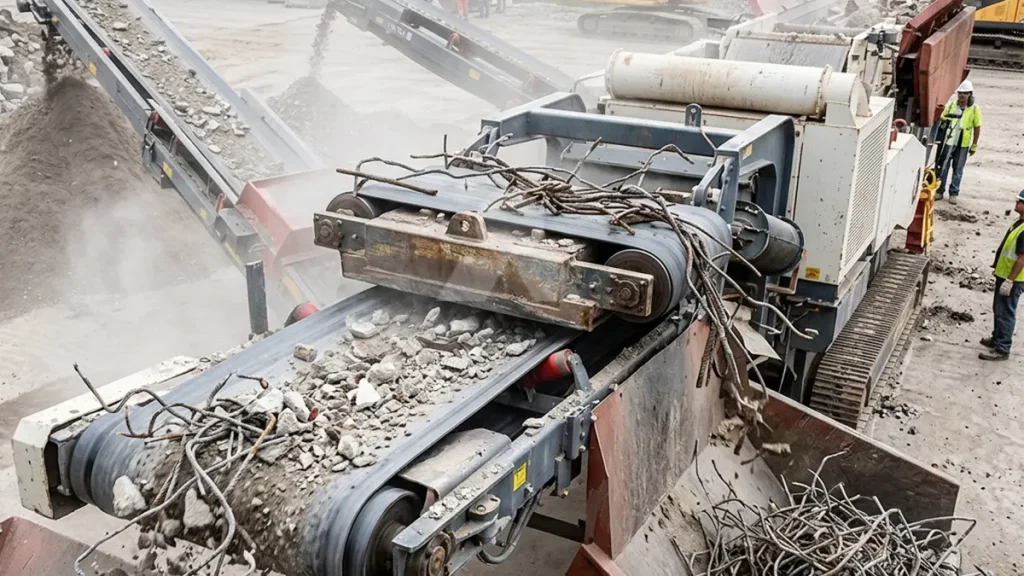
As the VTI1313 shatters the concrete, the impact mechanics naturally detach the cement from the embedded rebar. A self-cleaning magnetic separator suspended over the main discharge conveyor instantly pulls the liberated steel from the aggregate stream. This guarantees the recycled gravel meets strict purity standards for road-base applications, directly accelerating the hardware amortization cycle through the sale of both the aggregate and the scrap steel.
Urban Emission Diagnostics & Acoustic Adherence Post-Mortem
- What physical evidence proves a demolition site is failing particulate compliance?
- I reviewed an environmental injunction last month where silica dust had coated the windows of adjacent office buildings. The contractor was operating an open-circuit jaw without atomized misting. Proper deployment requires misting nozzles calibrated at the feed throat and discharge belt to trap the dust before it achieves aerodynamic lift.
- Historically, why did developers view on-site crushing as a regulatory liability?
- A decade ago, mobile crushers lacked acoustic insulation and emitted deafening diesel engine noise, resulting in immediate community complaints. Modern tracked units integrate acoustic canopies and offer electric-drive (plug-in) capabilities, completely neutralizing the noise and emission profiles that previously disqualified them from urban use.
- Why must C&D waste be processed with an impactor rather than a cone crusher?
- Do not feed rebar into a cone crusher. The hydraulic clamping force of a cone will attempt to crush the unyielding steel, resulting in catastrophic damage to the eccentric shaft. An impact crusher’s open cavity allows the steel to bend and pass safely through to the magnetic separator.
- How does on-site recycling specifically influence LEED certification?
- Calculating the project’s sustainability score proves that repurposing 100% of the demolition waste on-site earns major credits in the Materials and Resources (MR) category. It drastically reduces the embodied carbon of the project by eliminating the transport logistics associated with acquiring virgin aggregate.
Enforce Regulatory Adherence to Secure Project Viability
Modern municipalities will not tolerate environmental negligence. Integrating the Mobile Crusher in Sustainable Construction proves that high-capacity demolition and strict regulatory adherence are not mutually exclusive. If you attempt to execute an urban renewal project using traditional haul-and-dump logistics, your expenditure per shift will be consumed by landfill taxes, transport fuel, and inevitable environmental fines. Deploy a tracked, emission-controlled recycling circuit to secure your permits, purify your aggregate, and validate your commitment to sustainable development.